
Campervan DC-DC Charger Guide: Do You Need One?
A campervan DC-DC charger is one of the most important parts of a modern off-grid electrical system.
It charges your leisure battery while you drive, using power from the vehicle alternator. As a result, it can keep your campervan battery topped up even when solar output is poor or you are moving between locations.
However, not every van uses the same charging setup. Older vehicles, smart alternators, lithium batteries and different battery sizes all need the right approach.
VanVolt builds matched DIY campervan electrical packages around your vehicle, appliances, charging plans and off-grid needs. That means the DC-DC charger, battery, cabling, fuse protection and other charging equipment all need to work together.
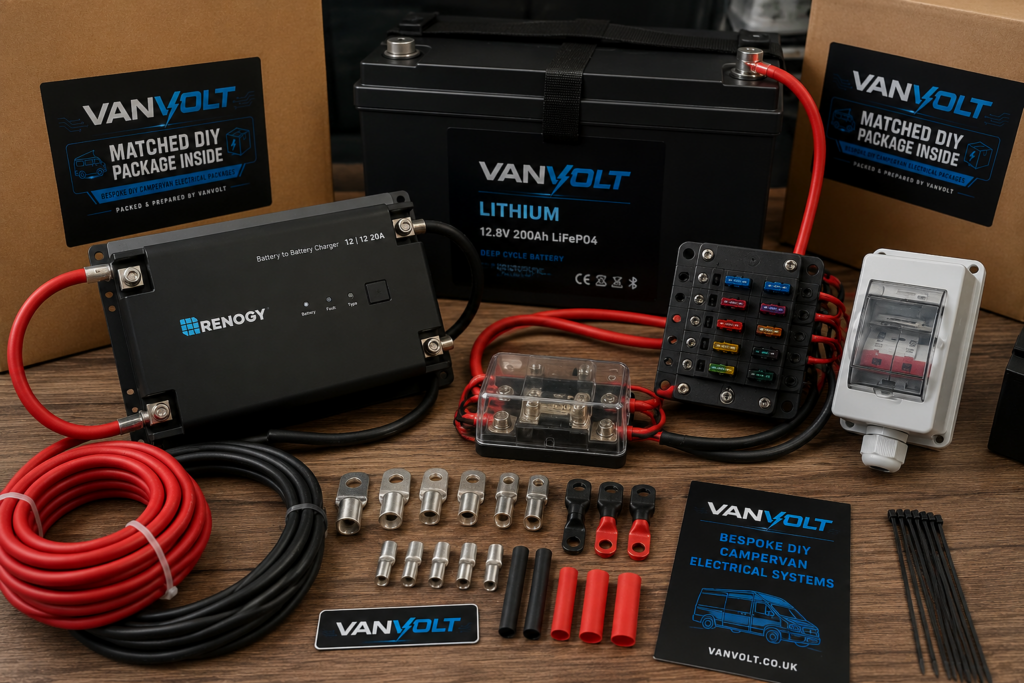
What Is a Campervan DC-DC Charger?
A campervan DC-DC charger is a battery charger that connects between your vehicle starter battery and leisure battery.
When the engine runs, it takes power from the vehicle side and converts it into a suitable charging profile for the leisure battery.
This matters because leisure batteries need controlled charging. Lithium batteries, in particular, need the correct voltage and charging behaviour.
A DC-DC charger can help with:
- Charging while driving
- Protecting the starter battery
- Supporting lithium battery charging
- Working with smart alternators
- Improving charging control
- Reducing reliance on campsite hook-up
- Supporting off-grid touring
In simple terms, solar charges while parked. A DC-DC charger charges while driving.
For many campervan builds, both are useful.
Do You Need a DC-DC Charger in a Campervan?
In most modern campervan builds, yes.
A DC-DC charger is strongly recommended if you have a lithium leisure battery, a smart alternator vehicle or you want reliable charging while driving.
Older split-charge relay systems can work on some basic setups. However, they are not usually the best choice for lithium batteries or modern vehicles.
| Setup type | DC-DC charger needed? | Why |
|---|---|---|
| Lithium leisure battery | Usually yes | Needs controlled charging profile |
| Smart alternator vehicle | Usually yes | Alternator voltage can rise and fall |
| AGM or lead-acid battery | Often useful | Improves charging behaviour |
| Solar-only setup | Not always, but recommended for touring | Gives charging while driving |
| Campsite hook-up only | Depends on use | Mains charging may be enough for simple vans |
| Off-grid touring van | Yes | Adds reliable recharge during journeys |
Therefore, if you want a dependable campervan electrical system, a DC-DC charger is usually part of the plan.
Why Smart Alternators Changed Campervan Charging
Many modern vans use smart alternators.
A traditional alternator often charges at a fairly steady voltage. By contrast, a smart alternator can adjust output depending on engine load, battery condition and vehicle efficiency systems.
This can cause problems for old-style split-charge relays.
The leisure battery may not charge properly, or the charging behaviour may become inconsistent. As a result, your battery can sit below full charge even after a long drive.
A campervan DC-DC charger solves this by managing the charging process properly. It takes the vehicle-side input and delivers a suitable charge to the leisure battery.
That is especially important when using LiFePO4 batteries.
DC-DC Charger vs Split Charge Relay
A split charge relay is a simpler device. It connects the starter battery and leisure battery when the engine runs, then separates them when the engine stops.
A DC-DC charger is more advanced. It actively controls the charge going into the leisure battery.
| Feature | Split charge relay | DC-DC charger |
|---|---|---|
| Basic charging while driving | Yes | Yes |
| Suitable for lithium batteries | Usually not ideal | Yes, when lithium compatible |
| Works well with smart alternators | Often no | Yes |
| Controlled charging profile | No | Yes |
| Better battery protection | Limited | Stronger |
| Best for modern campervans | Rarely | Usually |
For a simple older van with a lead-acid leisure battery, a split-charge relay may still work. However, for most lithium campervan builds, a DC-DC charger is the better route.
What Size DC-DC Charger Do You Need?
The right size depends on your leisure battery capacity, vehicle alternator, cable run and how quickly you want to recharge.
Common campervan DC-DC charger sizes include 20A, 30A, 40A, 50A and 60A.
A higher-amp charger can refill the battery faster. However, it also needs suitable cabling, fusing and alternator capacity.
| DC-DC charger size | Typical use |
|---|---|
| 20A | Small systems and lighter charging needs |
| 30A | Basic lithium or AGM campervan setups |
| 40A | Good all-round option for many touring vans |
| 50A | Stronger charging for larger lithium batteries |
| 60A | Higher-capacity systems where the vehicle supports it |
For many VanVolt-style DIY campervan packages, a 40A DC-DC charger is a practical and popular size. However, the correct choice depends on the vehicle and battery system.
That is why it should not be guessed.
DC-DC Charger Size and Battery Capacity
Battery size matters when choosing a charger.
A 100Ah lithium battery does not always need a very large DC-DC charger. By contrast, a 300Ah lithium battery may benefit from stronger charging if you want to recover power quickly after off-grid use.
| Leisure battery size | Typical DC-DC charger range |
|---|---|
| 100Ah lithium | 20A–40A |
| 200Ah lithium | 30A–50A |
| 300Ah lithium | 40A–60A |
| 460Ah+ lithium | Case-by-case design |
These are general starting points, not fixed rules.
For example, a customer who drives every day may need less charging power than someone who parks for three nights and then wants a quick recharge on the road.
The alternator also matters. Some vehicles can support stronger charging more comfortably than others.
VanVolt Build Tip
Do not choose a DC-DC charger by amp rating alone. The charger must suit the van, battery capacity, cable length, fuse protection and how you travel.
Not sure what size you need? Complete VanVolt’s Build My Setup form and we will recommend a matched DIY electrical package around your actual van and appliances.
Start here: https://vanvolt.co.uk/build-my-setup/
Does a DC-DC Charger Replace Solar?
No. A DC-DC charger and solar charger do different jobs.
A DC-DC charger works when you drive. Solar works when daylight hits the panels.
For most touring campervans, the best setup uses both.
| Charging method | Best for | Limitation |
|---|---|---|
| DC-DC charging | Recharging while driving | Does nothing when parked |
| Solar charging | Topping up while parked | Weather and shade affect output |
| Mains charging | Campsite hook-up and pre-trip charging | Needs access to 230V supply |
Together, these charging routes make your campervan more flexible.
For instance, solar may keep your fridge running while parked in summer. However, a DC-DC charger can recover power quickly after a cloudy few days when you start driving again.
Do You Still Need a Mains Charger?
Often, yes.
A mains charger lets you charge the leisure battery from 230V hook-up or at home before a trip. It is especially useful for winter use, storage periods and campsite stays.
A balanced campervan charging setup may include:
- DC-DC charger for driving
- Solar controller for daylight charging
- Mains charger for hook-up and pre-trip charging
This gives you several ways to recover energy.
As a result, you are less dependent on one charging method.
Why Fuse Protection Matters
A DC-DC charger connects to high-current vehicle electrics. Therefore, the circuit needs proper protection.
A correct installation normally includes suitable fuses near the power sources, correctly sized cable and secure terminations.
The fuse rating and cable size depend on the charger current, cable length and equipment instructions.
Do not run a DC-DC charger through thin cable or unfused wiring. Poor protection can cause overheating, voltage drop and safety issues.
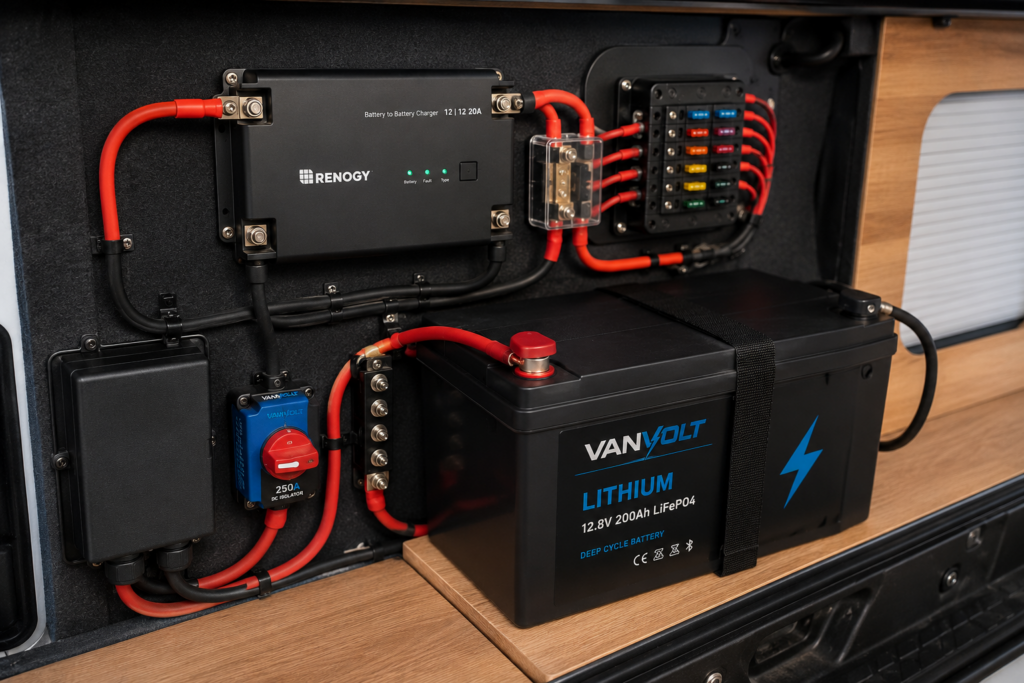
A proper VanVolt package includes the charging equipment and supporting parts needed to build the system properly, rather than only supplying the headline charger.
Common DC-DC Charger Mistakes
Buying the charger before checking the vehicle
Different vehicles have different alternators and electrical behaviour.
Therefore, always consider the van before choosing the charger size.
Using cable that is too small
Undersized cable can cause voltage drop and heat.
As a result, the charger may not perform properly, and the installation may become unsafe.
Forgetting fuse protection
Fuses protect the cable and system if something goes wrong.
They should not be treated as optional extras.
Choosing too much charging current
A bigger charger is not always better.
The alternator, battery and wiring must all support the current safely.
Mixing random parts
A DC-DC charger is only one part of the system.
The battery, solar controller, mains charger, busbars, fuses, cable and monitoring equipment must all work together.
Is a DC-DC Charger Worth It?
For most modern campervan builds, yes.
It gives you reliable charging while driving, supports lithium batteries and makes off-grid travel easier. In addition, it reduces the chance of arriving somewhere with a battery that has not charged properly.
A campervan DC-DC charger is especially worthwhile if:
- You have a lithium leisure battery
- Your van has a smart alternator
- You spend time away from hook-up
- You drive between camping spots
- You run a compressor fridge or diesel heater
- You want solar and alternator charging together
- You are upgrading from an old split-charge system
For a serious DIY campervan electrical system, it is one of the core components.
When Should You Use Build My Setup?

Use VanVolt’s Build My Setup form before buying a DC-DC charger if you are unsure what your system needs.
Tell us:
- Your van make, model and year
- Your existing leisure battery setup
- Whether you have lithium, AGM or lead-acid
- What appliances you want to power
- How many nights you stay off-grid
- Whether you want solar
- Whether you use hook-up
- Whether you need an inverter
- Your preferred budget
VanVolt can then recommend a matched DIY campervan electrical package with the right battery, DC-DC charger, solar, mains charging, cabling, protection and outlets where needed.
Final Thoughts
A campervan DC-DC charger is one of the best upgrades for reliable off-grid power.
It charges your leisure battery while you drive, supports modern lithium systems and works far better than old split-charge methods in many modern vans.
However, the charger must suit the full system. Battery size, alternator behaviour, cable length, fuse protection and travel habits all matter.
Complete VanVolt’s Build My Setup form for a matched package recommendation based on your van and appliances. For daily campervan electrical tips, real package builds and off-grid inspiration, follow VanVolt on Facebook